

Waterproof Makeup That Lasts Through Tears: A Pro Routine
A waterproof mascara cannot protect an entire bridal look. Build a tear-resistant routine around preparation in the week before the wedding, considered application and clear instructions for absorbing tears without dragging the makeup.

By Raphael Oliver
· 10-minute read
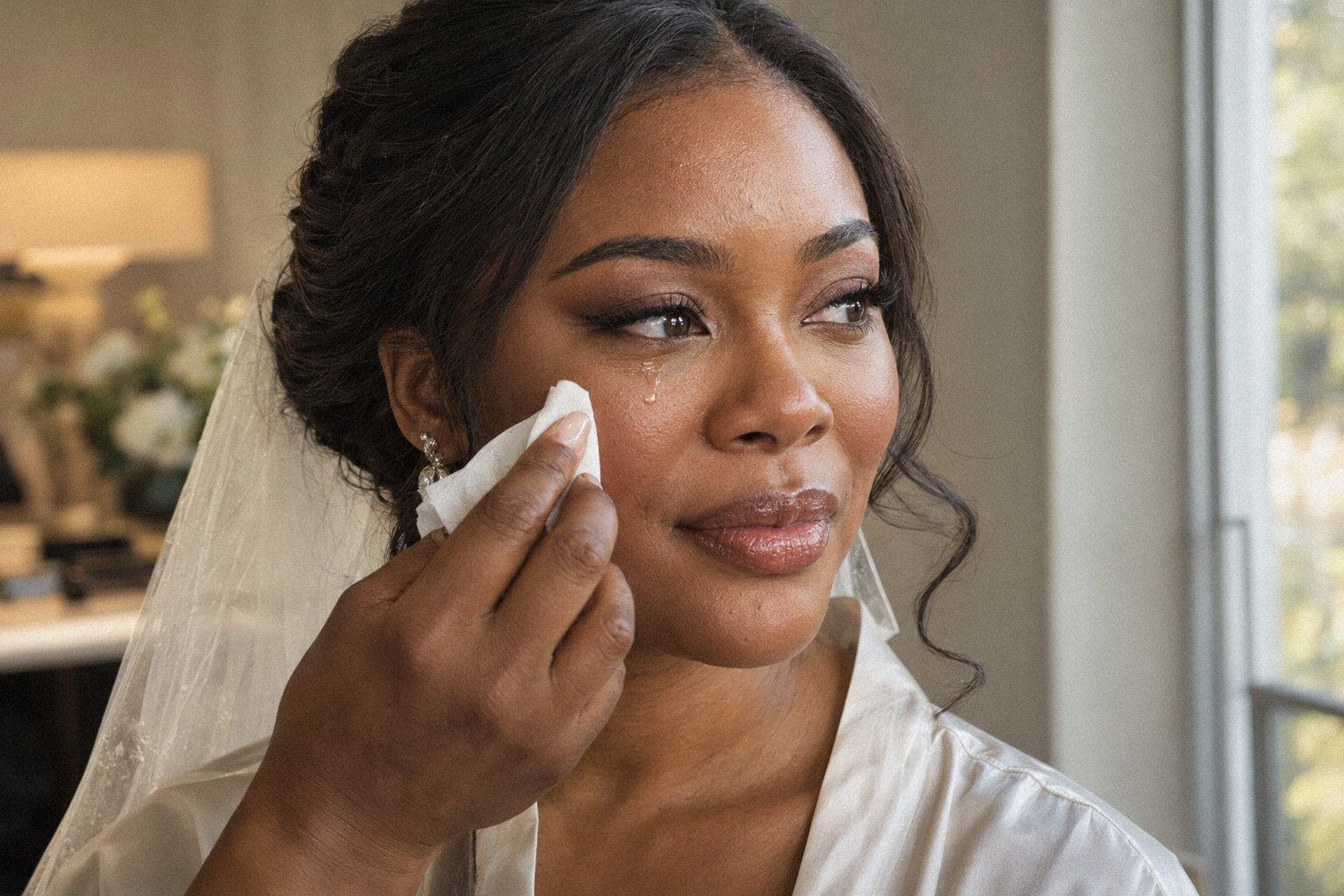
Waterproof makeup that lasts through tears needs more than waterproof mascara: it requires considered preparation, a reliable application technique and eye products chosen for moisture resistance. In my LockedBeauty™ method, I do not reduce coverage simply because a bride expects to cry. I choose the amount of product according to her skin, her age and the finish we want, paying particular attention to lines around the eyes.
In short:
- Ask the bride to care for and moisturise her face and lips during the week before the wedding.
- Choose coverage according to the client’s skin and lines—not the assumption that tears will melt a fuller application.
- Test the complete routine, including waterproof eye products, and set where needed.
- Teach the client to absorb tears with a soft tissue without dragging it across the makeup.
How do you make makeup last through tears?
Begin preparation before the wedding day. Ask the bride to keep her face and lips well moisturised during the preceding week, so the appointment does not depend on a heavy application of moisturiser. On the day, prepare the skin, apply compatible complexion products with control, set selectively and choose waterproof eye makeup. Allow products to settle and demonstrate how to absorb tears without wiping.
Plan the sequence before opening your kit
For a detailed bridal eye, use this order: skin preparation, eye primer, shadow and liner, fallout clean-up, complexion, cheek colour, powder, mascara and finishing spray. Let mascara dry before misting, and follow the spray’s directions. Keep the client’s eyes closed during application.
Allow drying time within the appointment rather than rushing straight from wet skincare to foundation. For the wider wedding schedule, use our all-day wedding makeup plan.
What makes waterproof makeup that lasts through tears different?
Water resistance depends on the finished formulas and how they work within the complete application—not simply on adding more powder or using less foundation. Film-forming ingredients help create coatings whose properties influence durability and removal. Preparation, product compatibility and application technique all deserve attention.
Read the claim, then test the product
Treat these categories as selection guides, not interchangeable guarantees. A label alone does not tell you how your complete bridal application will behave; assess the products together at the trial.
| Formula or claim | What to expect | Removal approach |
|---|---|---|
| Waterproof | Designed to resist water; not automatically resistant to rubbing or oil | Usually a dedicated waterproof remover; check directions |
| Water-resistant | Some moisture resistance; do not assume the same performance as another product | Follow the individual formula’s instructions |
| Smudge-resistant | Targets migration or transfer; does not necessarily promise tear resistance | Depends on the formula |
| Tubing mascara | Forms coatings around lashes; assess water resistance separately | Many release with warm water and gentle pressure; check directions |
Water resistance and warm-water removal can coexist through film design. That is why removal instructions matter as much as the word “waterproof” when comparing mascara technologies.
How do makeup artists keep foundation from streaking when a client cries?
Focus on preparation, application technique and how the client handles tears. Do not automatically reduce foundation or concealer beneath the eyes because you expect crying. Choose the coverage the client needs, then assess how that amount sits on her skin—especially around expression lines.
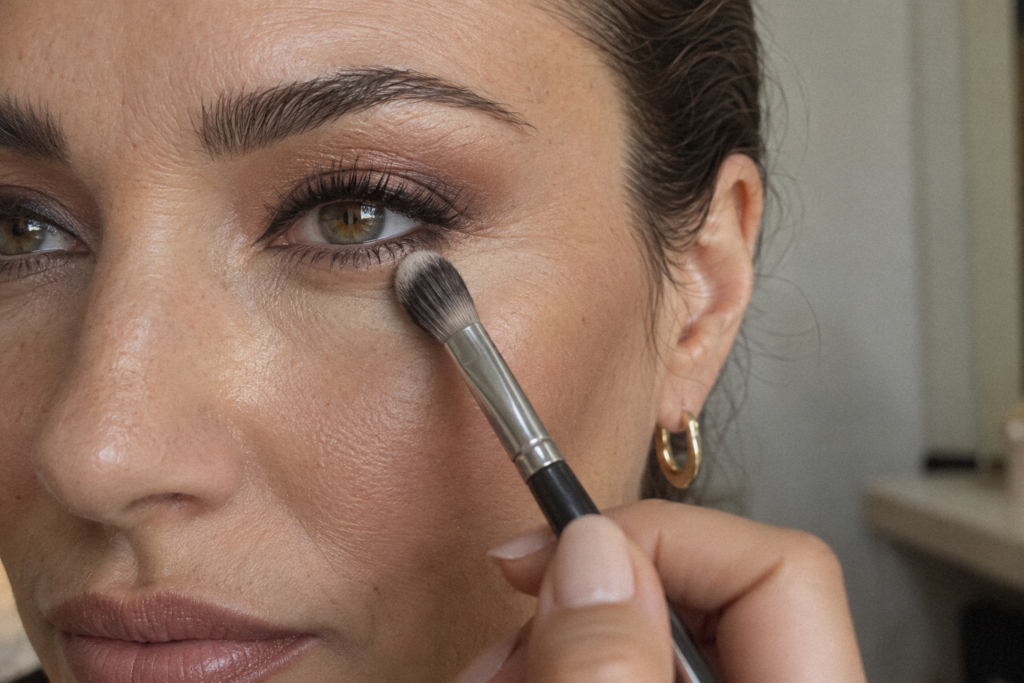
Build the complexion in six controlled steps
- Plan preparation before the appointment. Ask the bride to moisturise her face and lips consistently during the week before the wedding. On the day, match preparation to her skin rather than automatically applying a rich layer everywhere. Treat combination skin by zone and remove surface excess before makeup.
- Place primer selectively. Try a mattifying primer through an oily centre and a hydrating or gripping primer where appropriate. Use the amount directed; do not assume more grip requires more product.
- Check compatibility on the face. Apply your intended foundation over the prepared skin. If it pills, stop and reset that patch with fewer layers rather than buffing harder. Do not rely solely on “water-based” versus “silicone-based” labels.
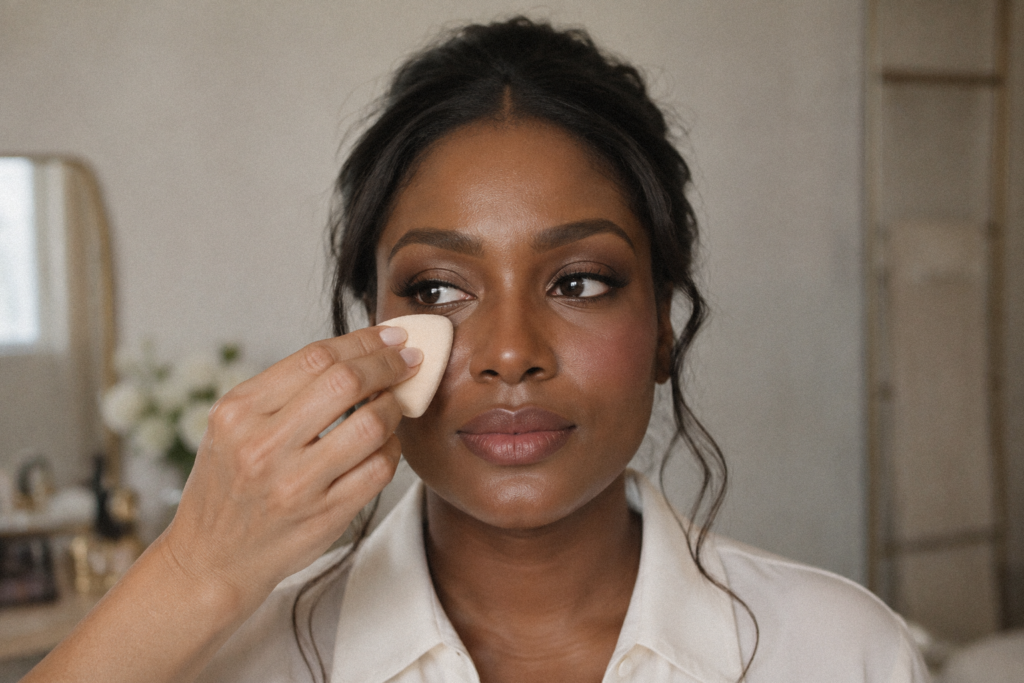
- Build the required foundation coverage. Use a small synthetic brush or barely damp sponge to apply an even layer, then assess where more coverage is needed. Let the client’s skin, the brief and the way the product sits guide the quantity—not the expectation of tears.
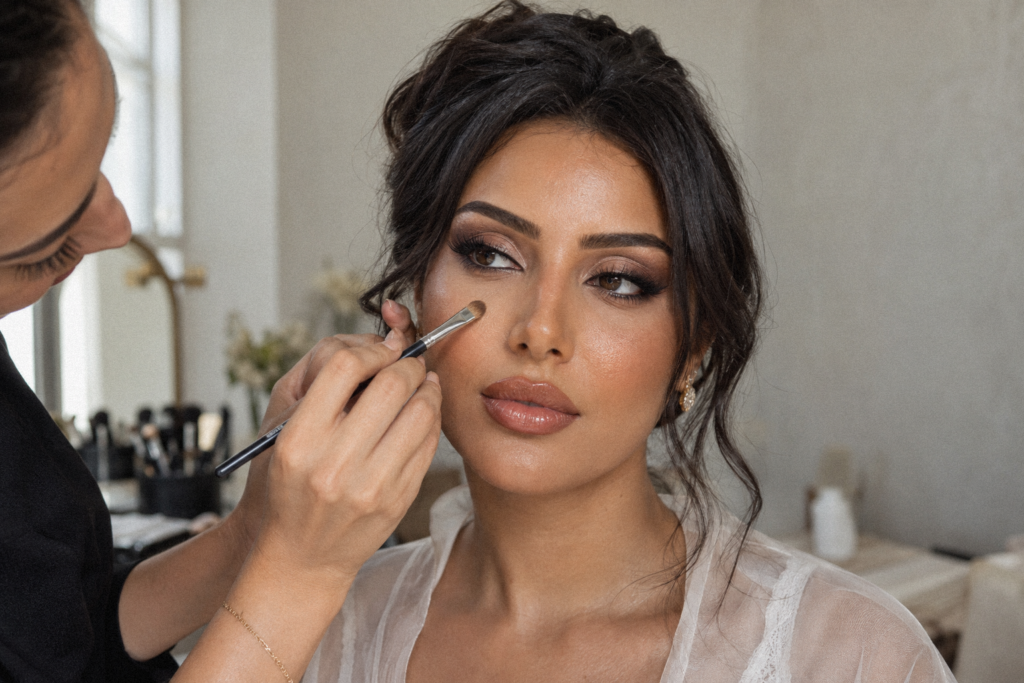
- Place concealer and cream colour deliberately. Apply concealer where correction is needed, checking the under-eye area for product collecting in lines. The client’s age and visible skin texture should inform the amount used. Tap on cream blush before powder.
- Set by location. Smooth any creasing, then press a suitable amount of powder beneath the eyes, beside the nose and through oily areas. For layered cheek colour, lightly press a matching powder blush over the cream.
Adapt the finish from fair to deep skin tones
Test powder over the finished foundation in daylight and with the intended photography lighting. On fair skin, avoid adding unwanted yellow or peach; on medium and olive skin, check for a pink or grey shift. On dark skin, select a genuinely sheer or appropriately tinted powder rather than assuming a pale “translucent” shade will disappear.
For a luminous brief, keep the centre softly set and place restrained satin highlight high on the cheekbone. For mature or dry under-eyes, assess how concealer and powder sit in lines before adding more. Reducing excess here is a finish decision, not a rule about tears dissolving coverage.
LockedBeauty™ for bridesBridal Makeup MasterclassLearn the LockedBeauty™ bridal method for makeup that withstands tears, heat and a long celebration.Learn more →In my LockedBeauty™ method, I do not use less product around the eyes simply because a bride may cry. For me, resistance comes from the technique, not from reducing coverage. What guides the quantity is the client’s age and whether the product is emphasising lines. That is the important distinction: I adjust the amount to preserve a polished finish, rather than out of concern that tears will melt the makeup.
Is waterproof mascara or tubing mascara better for watery eyes?
For expected tears, start by trialling a waterproof formula. Consider tubing mascara when easy removal and transfer control are priorities, but judge the individual product rather than assuming every tubing formula performs identically. Film chemistry can produce very different combinations of water resistance and removability.
Build an eye look with fewer vulnerable edges
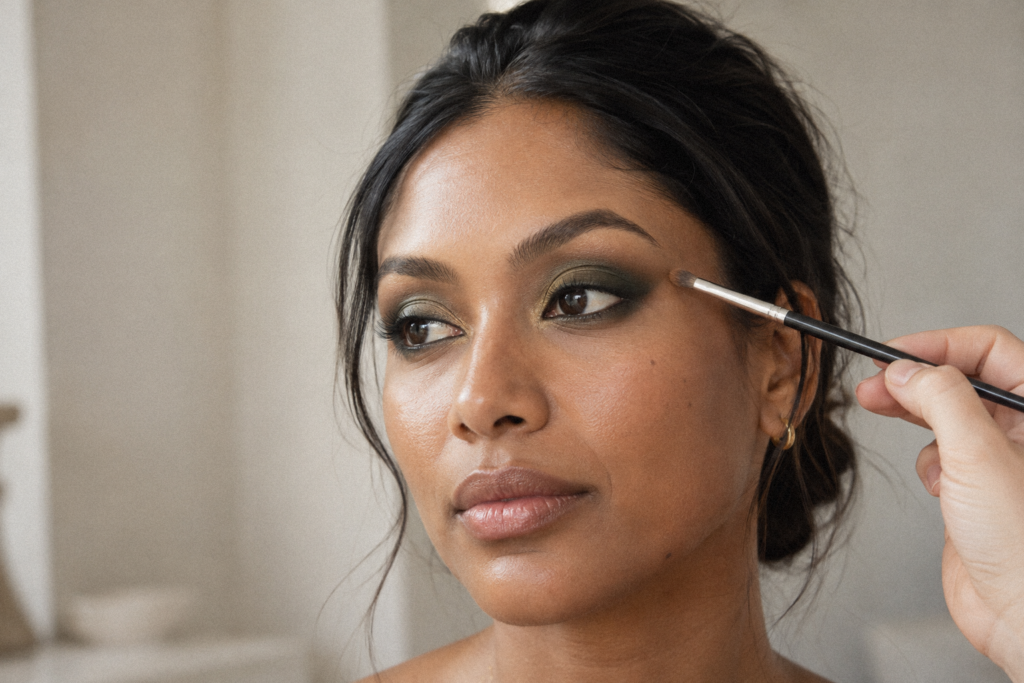
Apply a thin eye primer, followed by powder shadow or a self-setting cream or stick eyeshadow. Do not assume every creamy shadow sets. Keep waterproof liner close to the upper lash roots and consider leaving the lower lashes bare for a client who waters frequently.
- Hooded eyes: let liner and cream shadow set before the client fully opens their eyes; check the lid-contact area.
- Monolids: assess placement with eyes open and keep the mobile-lid layers thin.
- Deep-set eyes: check whether the lash tips touch the upper lid during blinking.
- Frequently watery eyes: keep pigment away from the tear duct and avoid adding waterline detail to an already uncomfortable eye.
Choose a lash band that fits without crowding the inner corner; our false-lash placement guide by eye shape covers fitting decisions. Do not introduce an unfamiliar adhesive casually on the wedding morning. Stop using any eye cosmetic that causes discomfort.
Does setting spray make makeup waterproof?
No setting spray should be treated as a universal waterproofing guarantee. Choose one whose stated purpose matches the job, rather than assuming a hydrating finishing mist and a long-wear sealant are equivalent. It belongs within a considered routine; it does not replace application technique.
Finish without soaking the application
Follow the labelled distance and quantity, allow the mist to dry undisturbed and avoid repeatedly drenching the face. Use specialist sealants only on their approved areas, and do not use a product near the eyes unless it is specifically intended for that use.
Run a realistic bridal wear test
At the trial, record the skincare, quantities, placement and drying sequence. Photograph the look immediately and several hours later; check lid transfer, under-eye creasing, cheek wear and removal comfort. Use those observations to refine the application and agree on preparation for the week before the wedding.
With the client’s consent, test a small drop of clean water on the finished outer cheek and practise absorbing it with tissue. Treat this only as a limited water-and-blotting check—not proof against tears. Never deliberately irritate the eyes to produce crying.
How do you touch up makeup after crying without smearing it?
Absorb the tear first with a soft paper tissue, without dragging it across the face. Do not assume crying means the makeup needs replacing. Once the surface is dry, assess the finish and correct only if something has actually moved.
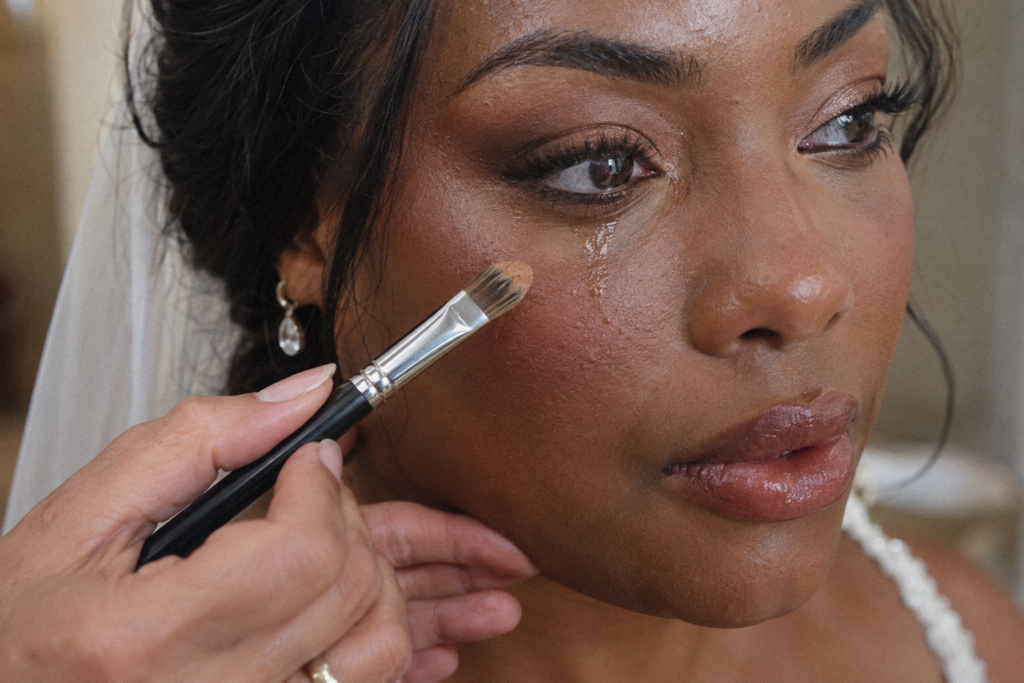
Use the absorb, assess, repair sequence
- Absorb. Rest the corner of a soft, clean tissue against the tear on the cheek. Lift it away without dragging or touching the eyeball.
- Pause. Let the surface dry. Avoid rubbing lashes between tissue or fingers.
- Assess. Check whether anything needs attention: missing foundation, displaced pigment or a lifted lash corner. If the makeup is intact, leave it alone.
- Repair only if needed. Lift loose pigment carefully with a clean tool. If coverage has lifted, tap a trace of matching foundation into the bare track using a small brush, then feather only its edge. Do not apply foundation or powder across a wet tear track.
- Reset selectively. Add the smallest necessary amount of powder once any correction has settled. Restore blush only if colour was lost.
Pack soft tissues, a clean mini sponge, a small brush, matching complexion product, pressed powder and lip colour. Demonstrate the tissue motion before the ceremony rather than leaving the client to interpret “dab, don’t rub”.
My guidance starts a week before the wedding: take good care of the face and lips and keep them well moisturised. I do not want to rely on a heavy application of moisturiser on the wedding day, because that can compromise wear. For tears, my instruction is simple: absorb them with a paper tissue, without dragging it over the skin. With my technique, that is all I expect the bride to need—not an automatic makeup repair.
How do you remove waterproof makeup without rubbing your eyes?
Choose a remover intended for your waterproof eye products; an eye-safe oil-based or dual-phase remover is often appropriate. Follow tubing mascara’s own directions instead of automatically using the same removal method.
- Remove false lashes according to the adhesive’s directions; never pull against resistance.
- For a dual-phase remover, shake as directed and saturate a soft pad without leaving it dripping.
- Hold it gently over the closed eye for the directed contact time, then wipe lightly. Repeat with a clean section rather than scrubbing.
- Remove the complexion with a suitable cleanser and rinse as directed.
Keep remover and tools out of the eye itself. Stop if removal causes discomfort; do not respond by rubbing harder or repeatedly applying more product.
From the AcademyMakeup Art — Artistic Makeup SpecializationTurn color, precision and creativity into your signature style, with 5 artistic looks taught step by step.Discover Makeup Art →FAQ
Use these final checks to make the routine practical beyond the makeup chair.
Should I skip moisturiser on oily skin?
Do not automatically omit it, but do not apply a heavy layer by default either. Match the amount and texture to the client’s skin, assess the result at the trial and remove surface excess before primer. My preference is consistent preparation during the preceding week rather than trying to do everything on the wedding morning.
Should I use less concealer if the bride expects to cry?
Not simply because of tears. In my LockedBeauty™ method, I choose the amount according to the coverage needed and how the product sits around the eyes. Age and lines matter to that decision; anticipated crying is not, by itself, a reason to reduce coverage.
Can I mix a sealant directly into foundation?
Only if the manufacturer explicitly permits that combination. Otherwise, keep the products separate and follow their specified application order.
What should I do if mascara dries out before the wedding?
Replace it rather than adding water or saliva. Do not improvise changes to the formula to make it usable for the appointment.
LockedBeauty™ Method — Raphael Oliver
Want to develop your bridal technique further? Explore Raphael Oliver’s Bridal Online Masterclass through Raphael Oliver Academy.
Keep your final checklist practical: preparation during the week before the wedding, a tested technique, coverage chosen for the client’s skin and a demonstrated way to absorb tears. The goal is not to stop your client crying—it is to let her enjoy the moment with clear, simple guidance on caring for her makeup.



The conversation
Join the conversation
A question, an experience or a different approach? Share it below.
No comments yet — be the first to share your thoughts.